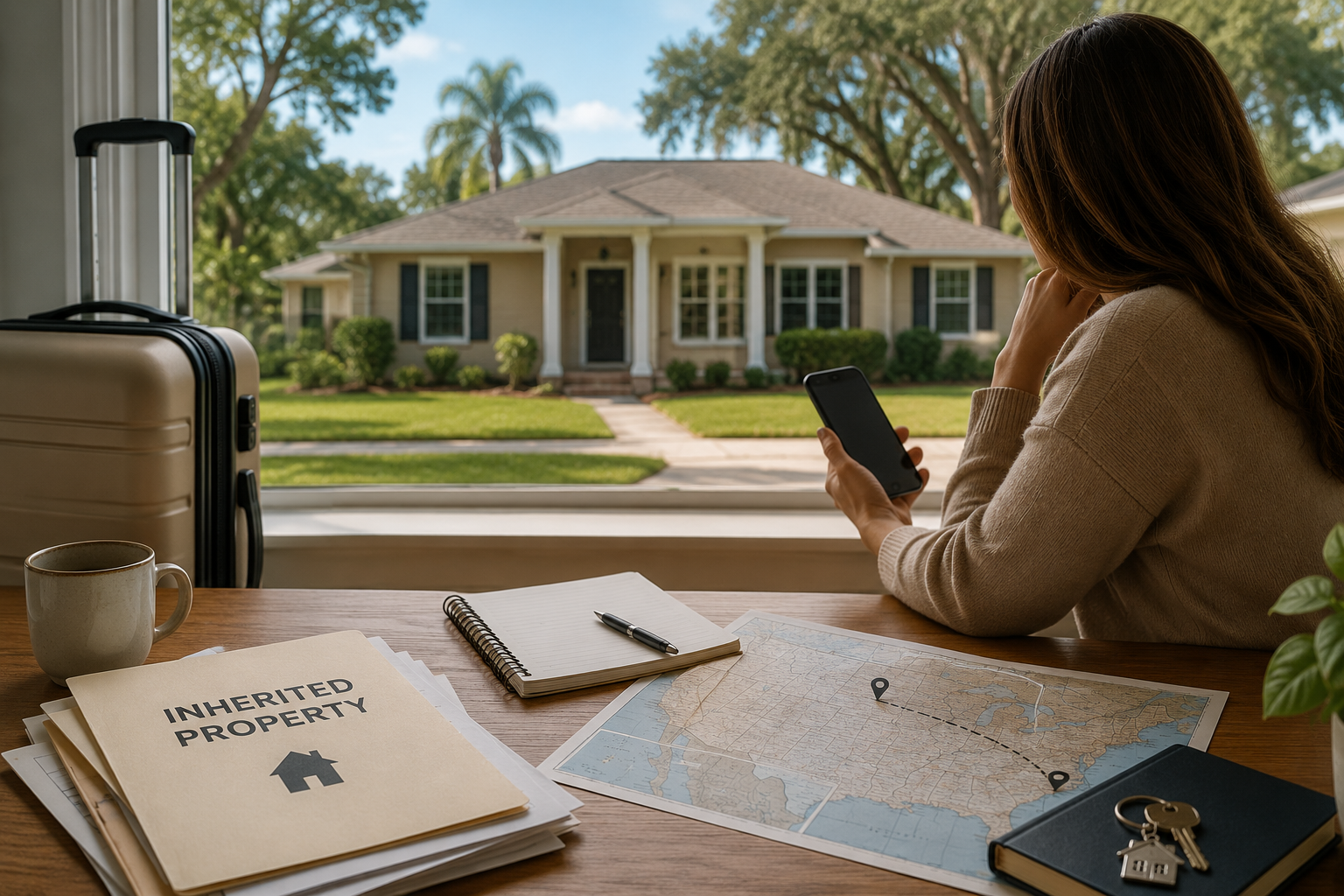
Handling an inherited house can be challenging when you live nearby.
Doing it from another state can feel like an entirely different problem.
Maybe you’re serving as the personal representative of an estate in Florida, but you live in Georgia, New York, North Carolina, Texas, or somewhere else entirely.
You already have a probate attorney helping with the legal process. But there’s still a house in Jacksonville that someone needs to deal with.
Who checks on it?
Who cuts the grass?
Is the homeowners insurance still appropriate if nobody is living there?
What happens to everything inside?
Does the house need repairs?
And eventually, should the family keep it, rent it, or sell it?
The good news is that you don’t necessarily need to travel to Jacksonville every time something needs to happen at the property.
Here are some of the things to consider when you’re responsible for an inherited property in Jacksonville but live somewhere else.
1. Make Sure Someone Is Checking on the Property
If the house is vacant, this should be one of your first priorities.
A property can develop problems quickly when nobody is regularly checking on it.
A small plumbing leak could go unnoticed.
A tree limb could damage the roof during a storm.
The air conditioning could stop working.
Mail could pile up.
The lawn could become overgrown.
Someone could break into the property.
Even if you aren’t ready to decide what to do with the house, someone local should be keeping an eye on it.
If the property will remain vacant for a while, consider having someone periodically check both the interior and exterior and report any problems they find.
A vacant property may need some additional protection while the estate is being handled.
Read: How to Protect a Vacant House During Probate in Florida →
2. Contact the Insurance Company
Don’t assume the existing homeowners insurance policy will continue operating exactly the same way after the homeowner has passed away or when the property is sitting vacant.
Contact the insurance company or insurance agent and explain the situation.
Tell them:
- The homeowner has passed away
- The property is part of an estate
- Whether anyone currently lives in the home
- Whether the home is furnished
- How long you expect it to remain unoccupied
Most importantly, ask whether the property’s occupancy status changes the coverage or whether different insurance is needed.
Every policy is different, so this is something to address directly with a licensed insurance professional.
3. Make the House Look Cared For
A house doesn’t need to look abandoned just because nobody is living there.
If you’re managing the property from another state, arrange for someone to handle basic exterior maintenance.
That may include:
- Lawn service
- Trimming overgrown landscaping
- Removing mail, newspapers, and packages
- Taking trash cans in
- Checking exterior lighting
- Inspecting doors and windows
- Watching for HOA or code-enforcement notices
The goal is simple:
Make the property look maintained and monitored.
This can also make it easier to notice when something changes at the property.
4. Secure a Vacant Property
If nobody is living in the home, security deserves extra attention.
Check that doors and windows are properly secured and determine who currently has keys to the property.
Depending on the situation, you may also consider rekeying locks, exterior lighting, security cameras, an alarm system, or posting a No Trespassing sign.
I’ve put together a separate guide specifically for this:
Vacant House During Probate in Florida? Here’s How to Protect the Property
It covers insurance, unauthorized occupants, maintenance, security, and other issues to consider when an inherited home is sitting vacant.
If you’re responsible for a vacant probate or inherited property in the Jacksonville area, I also offer a free No Trespassing sign and installation for qualifying properties.
5. Don’t Rush to Empty the House
One of the biggest physical jobs may be everything inside the property.
Furniture.
Clothing.
Family photographs.
Documents.
Jewelry.
Tools.
Collections.
Vehicles.
Decades of personal belongings can be inside one house.
Before ordering a dumpster and clearing everything out, make sure you understand what should be preserved and coordinate with the appropriate family members and professionals.
Your probate attorney can advise you when there are questions about your responsibilities regarding estate property.
Once you know what can be handled, the physical cleanout might involve a combination of:
- Family members keeping sentimental items
- Selling valuable belongings
- Holding an estate sale
- Donating usable items
- Disposing of unwanted belongings
- Hiring a professional cleanout company
You don’t necessarily need to fly to Jacksonville and personally move everything yourself.
Local estate-sale and cleanout companies can handle much of the physical work when appropriate.
6. Find Out What the House Is Actually Worth
Before deciding whether to spend money repairing the property, it’s helpful to understand its value.
Online estimates can provide a rough starting point, but inherited properties often require a closer look.
Condition matters.
A house that hasn’t been updated in 25 years shouldn’t necessarily be evaluated the same way as the completely renovated house down the street.
When helping a family evaluate an inherited property, I generally want to understand three numbers:
What might the property sell for in its current condition?
What might it sell for after reasonable improvements?
What would those improvements actually cost?
Those numbers can help you determine whether investing additional estate money into the property makes financial sense.
7. Don’t Automatically Renovate the House
It’s easy to assume:
“We need to fix the house before we sell it.”
Sometimes that’s true.
Sometimes it isn’t.
Suppose a property needs $40,000 worth of renovations, but those improvements are only likely to increase the eventual net proceeds by $25,000.
Doing the renovation simply because buyers prefer updated homes wouldn’t make much financial sense.
On the other hand, there may be relatively inexpensive improvements that significantly improve the property’s marketability.
The decision should be based on the numbers rather than automatically choosing either:
“Fix everything.”
or
“Sell it exactly as it is.”
A good property evaluation should help you compare both options before the estate starts spending money.
8. Understand Your Options Before Deciding to Sell
Selling isn’t your only option.
Depending on the estate and the family’s circumstances, an inherited property might eventually be:
Kept
An heir or beneficiary may want to own or occupy the property.
Rented
The family may decide to keep the house as an investment property.
Sold As-Is
The estate may prefer a simpler sale without completing substantial repairs.
Prepared for the Traditional Market
Certain repairs, cleaning, landscaping, or cosmetic improvements may help the property attract a stronger traditional buyer.
You don’t have to decide immediately.
But understanding the condition, value, expenses, and potential options gives the family better information when the time comes to make that decision.
Always coordinate decisions involving estate property with your probate attorney when appropriate.
9. One Local Contact. A Network of Help.
Managing an inherited property from another state can mean coordinating a lot of moving pieces.
You shouldn’t have to search for a new person in Jacksonville every time something needs to be done at the house.
That’s where I can help.
I can serve as one local real estate resource in Jacksonville to help you understand what the property needs and connect you with trusted local professionals when additional help is necessary.
Depending on the property, that may include help with:
- Property Valuations — Understanding what the home may be worth in its current condition and after potential improvements
- Clean Outs — Connecting you with professionals who can remove unwanted belongings and prepare the property
- Estate Sales — Helping you find local estate-sale professionals when there are belongings worth selling
- Contractors — Connecting you with contractors and tradespeople when repairs are needed
- Landscapers — Keeping the exterior maintained when no one is living nearby
- Property Management — Connecting you with local management resources if the family decides to keep and rent the property
- Home Sales — Helping you compare selling as-is versus preparing the property for the traditional market
- Local Professionals — Connecting you with other Jacksonville professionals and property resources as needs arise
You can continue working with your probate attorney on the legal side of the estate while having one local point of contact for the real estate and property side.
For an out-of-state personal representative, that can mean fewer calls to make, fewer people to find on your own, and fewer unnecessary trips to Jacksonville.
10. You May Be Able to Handle More Remotely Than You Think
Living outside Florida doesn’t necessarily mean making repeated trips to Jacksonville.
A lot of the property-related process can potentially be coordinated remotely.
Photos and videos can document the home’s condition.
Contractors can provide estimates.
Cleanout companies can handle belongings once authorized.
Property updates can be provided by phone, email, photographs, and video.
And if the property is eventually sold, many parts of the real estate transaction can typically be coordinated without requiring you to be physically present for every step.
The exact legal requirements of your probate case should always be discussed with your attorney.
But from a property standpoint, distance doesn’t have to mean handling everything alone.
One Local Contact. A Network of Help.
Managing an inherited property from another state can be difficult when you don’t have someone local.
I can be your local Jacksonville resource for the property.
As a Realtor specializing in probate real estate, I can help you understand the property’s value, get local eyes on the house, and connect you with trusted professionals when needed.
Property Valuations • Clean Outs • Estate Sales • Contractors • Landscapers • Property Management • Home Sales
You don’t need to decide to sell before reaching out.
Disclaimer: This article is provided for general educational purposes only and is not legal, tax, or insurance advice. Probate cases and individual circumstances vary. Consult your Florida probate attorney regarding your authority and responsibilities as personal representative and appropriate licensed professionals for legal, tax, and insurance questions.